

This article contains discussions of mental health and sexual assault.
Emilia Clarke might not have played Daenerys Targaryen in the botched original pilot of “Game of Thrones,” but after taking over the role of the Mother of Dragons from actress Tamzin Merchant, she defined the lead role on David Benioff and D.B. Weiss’s “Game of Thrones” for a decade. Daenerys is, without question, the role of a lifetime for this British-born actress; still, she went through the wringer during and even after her time on “Game of Thrones.”
Let’s take a step back: who is Daenerys within the world of “Game of Thrones?” Also known as Khaleesi and, again, the Mother of Dragons — and later, Breaker of Chains — Daenerys Targaryen is one of the only living members left from House Targaryen, an ancient and royal house that ruled the fictional continent of Westeros for years. After Daenerys’ father King Aerys II Targaryen, also known as the “Mad King,” is overthrown by Robert Baratheon (Mark Addy), Daenerys and her only surviving brother Viserys (Harry Lloyd) flee across the Narrow Sea. When “Game of Thrones” begins, the two siblings are hellbent on taking back the Iron Throne of the Seven Kingdoms … and after Viserys is killed by Daenerys’ husband Khal Drogo (Jason Momoa) and Drogo also dies, she sets out on her own. Well, not on her own; she also has three dragons.
As for Clarke, this talented performer — who’s appeared on the big and small screen alongside stints on the stage on both Broadway and on London’s West End — has bravely endured some personal and professional struggles. Here are some of the tragic details of “Game of Thrones” star Emilia Clarke’s life, from health struggles to grieving loved ones to professional setbacks.
Emilia Clarke had a horrifying health scare during Game of Thrones
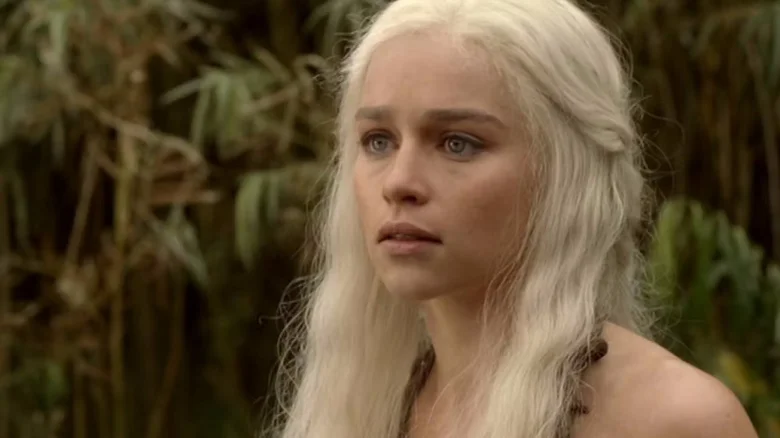
Anyone who watched the first few seasons of “Game of Thrones” likely never had any idea that Emilia Clarke was undergoing a serious personal health crisis, but in 2019, she penned a personal essay for The New Yorker explaining that she had not one but two intensive brain surgeries across those first initial seasons to deal with aneurysms. As Clarke recalled, she was exercising with her trainer when she “felt as though an elastic band were squeezing [her] brain,” and ultimately was overcome with pain to the point where she was physically sick. “At some level, I knew what was happening: my brain was damaged,” she wrote. So what was it? Clarke explained:
“The diagnosis was quick and ominous: a subarachnoid hemorrhage (SAH), a life-threatening type of stroke, caused by bleeding into the space surrounding the brain. I’d had an aneurysm, an arterial rupture. As I later learned, about a third of SAH patients die immediately or soon thereafter. For the patients who do survive, urgent treatment is required to seal off the aneurysm, as there is a very high risk of a second, often fatal bleed. If I was to live and avoid terrible deficits, I would have to have urgent surgery. And, even then, there were no guarantees.”
Clarke was treated at a hospital in London, and though the surgery was successful, she developed temporary memory loss and aphasia. “I’d never experienced fear like that—a sense of doom closing in. I could see my life ahead, and it wasn’t worth living,” she wrote. “I am an actor; I need to remember my lines. Now I couldn’t recall my name.” Though this passed, another crisis soon manifested.
Right when she felt safe, Emilia Clarke’s health issue resurfaced
In that same New Yorker personal essay — which, it should be said, required a significant amount of personal bravery to write in the first place — Emilia Clarke revealed that after her first neurosurgery, she was told that she had a second, smaller aneurysm that might need to be treated. Unfortunately, that did come to pass; after experiencing pain and other symptoms while she filmed Season 2 of “Game of Thrones,” she was told that she needed another procedure. In New York for a Broadway production of “Breakfast at Tiffany’s,” Clarke said she was told the second surgery would be “a relatively simple operation, easier than last time.” Apparently, that’s not how it shook out:
“When they woke me, I was screaming in pain. The procedure had failed. I had a massive bleed and the doctors made it plain that my chances of surviving were precarious if they didn’t operate again. This time they needed to access my brain in the old-fashioned way—through my skull. And the operation had to happen immediately.”
This much more serious operation happened right away and left Clarke in rough shape with a difficult recovery. “I felt like a shell of myself. So much so that I now have a hard time remembering those dark days in much detail,” she wrote. “My mind has blocked them out. But I do remember being convinced that I wasn’t going to live.” Live she did, and now, Clarke runs an organization called SameYou to help people afflicted by similar ailments. Still, there’s no downplaying precisely how frightening this all was for Clarke as she continued working on one of the biggest TV shows of all time.
After surviving two brain aneurysms, Emilia Clarke developed a new fear on Game of Thrones

Though Emilia Clarke’s aneurysm did not, that we know of, cause any further complications while she filmed “Game of Thrones.” Still, as she told Big Issue in 2024, she developed a brand new fear after dealing with so many serious health crises: she thought she’d get fired.
“When you have a brain injury, because it alters your sense of self on such a dramatic level, all of the insecurities you have going into the workplace quadruple overnight,” Clarke said to the outlet. “The first fear we all had was: ‘Oh my God, am I going to get fired? Am I going to get fired because they think I’m not capable of completing the job?'”
That’s why, Clarke says, she created SameYou. “Having a chronic condition that diminishes your confidence in this one thing you feel is your reason to live is so debilitating and so lonely,” she said earnestly. “One of the biggest things I felt with a brain injury was profoundly alone. That is what we’re trying to overcome.” This is a genuinely incredible thing for the star to do, and her commitment to serving people who have suffered from similar brain injuries and survived is truly admirable. Plus, as we all know, Clarke stuck around on “Game of Thrones” until the bitter end.
Nude scenes on Game of Thrones were difficult for Emilia Clarke
Nudity was so ubiquitous throughout the run of “Game of Thrones” that the word “sexploitation” was essentially created to describe scenes on the series where sex and nudity were displayed but served no narrative purpose. As a woman who’s forced into marriage with Khal Drogo and makes a habit out of emerging from fiery structures completely unharmed by the flames but fully nude, Emilia Clarke did plenty of nude scenes on “Game of Thrones,” and she found them personally challenging.
During an episode of “Armchair Expert with Dax Shepard,” Clarke said that because she was a relatively inexperienced performer when she won the role of Daenerys, she was frightened of the nude scenes … particularly because Drogo and Daenerys’s first sexual encounter verges on assault. Thankfully, she had Jason Momoa. “It’s only now that I realize how fortunate I was with that, because that could have gone many, many, many different ways,” Clarke told Shepard. “Because Jason had experience, he had done a bunch of stuff before coming on to this, he was like, ‘Sweetie, this is how it’s meant to be and this is how it’s not meant to be, and I’m going to make sure that’s the way it goes.” Not only that, but Momoa apparently always had a robe ready for Clarke. “He was so kind and considerate and cared about me as a human being,” she said.
Though Clarke did say later nude scenes got easier for her to “own,” it’s lucky that Momoa was there … and it’s frustrating to realize the experience could have been a lot worse for her.
Emilia Clarke pushed back against accusations that Game of Thrones was sexist

Ahead of the sixth season of “Game of Thrones,” Emilia Clarke sat down with Entertainment Weekly’s resident Westeros expert James Hibberd … and Hibberd noted that, especially after we watched scenes of brutal sexual assault in Seasons 4 and 5 of the series, people had distinct feelings about that. Clarke, for her part, pushed back on some of that.
“There’s so much controversy. Yet that’s what’s beautiful about ‘Game of Thrones’ — it’s depiction of women in so many different stages of development,” Clarke said. “There are women depicted as sexual tools, women who have zero rights, women who are queens but only to a man, and then there are women who are literally unstoppable and as powerful as you can possibly imagine,” she continued before saying she did take this personally, which makes sense when you consider that she was the show’s most prominent and powerful female character.
“So it pains me to hear people taking ‘Thrones’ out of context with anti-feminist spin — because you can’t do that about this show,” Clarke explained to Hibberd. “It shows the range that happens to women, and ultimately shows women are not only equal, but have a lot of strength.”
While it’s easy and even tempting at times to level accusations of sexism against “Game of Thrones,” the tragedy here is that it fell to Clarke — and not, say, showrunners David Benioff and D.B. Weiss — to defend the series.
Emilia Clarke’s two tentpole franchises flopped after Game of Thrones
Transitioning from a TV role into successful big-screen work is still tough for actors, even if they’re on something as huge and popular as “Game of Thrones” — and unfortunately, that’s true for Emilia Clarke, who turned out to have the worst franchise luck out of anybody on the HBO series.
In 2015, during the run of “Game of Thrones,” Clarke appeared alongside Jason Clarke and Jai Courtney in the reboot “Terminator: Genisys,” which was a critical flop and only a middling success at the box office. (It also almost killed the “Terminator” franchise.) Sadly, her next attempt at truly joining a franchise, 2018’s “Solo: A Star Wars Story” — where Clarke plays Qi’ra, childhood friend and romantic interest to Alden Ehrenreich’s Han Solo — was also a flop and became the first major “Star Wars” movie to genuinely flail at the box office.
So what has Clarke said about these two attempts at franchise gold? Nothing good! In 2018, Clarke spoke to Vanity Fair about working with her frequent “Game of Thrones” director Alan Taylor on “Genisys” and said that he was a changed man — and not in a good way. Taylor was, according to Clarke, “eaten and chewed up on ‘Terminator.'” Clarke continued: “He was not the director I remembered. He didn’t have a good time. No one had a good time.” This is unfortunate, but at least, after it flopped, Clarke could put her “Terminator” movie behind her.
When Game of Thrones ended, Emilia Clarke suffered a mental health crisis

Ending a series must be hard for actors — and when you consider that Emilia Clarke got her start on “Game of Thrones” and worked on the show for a full decade, it makes sense that it was really difficult for her to deal with the conclusion. As Clarke told the New York Times in 2026 while promoting her Peacock series “Ponies,” she showed up at the 2019 Emmy Awards for “Game of Thrones” and then hit a mental roadblock. “It was the first time in my professional life that I stopped,” Clarke said of the finality of “Game of Thrones” ending. “I had a full mental breakdown. It was almost as if the timing of the pandemic was bang on.”
Ultimately, Clarke says that the 2020 COVID-19 pandemic that trapped everyone in their homes did something for her. “It forced me to answer some questions I probably could have put off answering for another 10 years,” she said, and helped her reclaim some power in her career trajectory. It helped her, as Clarke put it, “realize that [she] could try and get some autonomy over [her] choices, [her] work.” This was partly due to her quick rise, as Clarke put it: “So much of my career didn’t reflect my taste, I just sort of shot out of a cannon.” That makes plenty of sense, and despite the horrors of that pandemic, that timing is weirdly fortuitous.
Emilia Clarke experienced a personal loss during Game of Thrones
During that extended COVID-19 lockdown, Emilia Clarke returned to a first love — reading — and showed specific love to a book of essays titled “Why Didn’t You Just Do What You Were Told?” by Jenny Diski in an Instagram post in early 2021. Diski passed away before this essay collection was published, and Clarke found her work truly moving … to the point where she also told the BBC that the book helped her grapple with the loss of her father.
In that same 2018 Vanity Fair interview where Clarke talked about the stress of making “Terminator: Genisys,” Clarke spoke about losing her father Peter Clarke to cancer in 2016 while she worked on “Game of Thrones,” saying, “It still sucks. Grief sucks. He doesn’t know what I’m doing now. That’s it before I start crying.” Then, in 2021, Clarke addressed Diski’s book … and how it helped her figure out how to understand this loss.
“The way that she writes about [death], it makes you feel OK,” Clarke said of Diski’s insightful work. “I lost my dad four years ago and it still feels like it was yesterday. And since his death I think about death a lot and I consider his a lot,” she continued. “And so to read her take on it was just really tonic for the soul.”
There was one big thing Emilia Clarke hated about her Game of Thrones ending

It’s no secret that the ending of “Game of Thrones” is deeply controversial, especially when it comes to Daenerys … who concludes her story by destroying King’s Landing and most of its population in the show’s penultimate episode from atop her remaining dragon Drogon. After that, Daenerys’s nephew and lover Jon Snow (Kit Harington) murders her for the good of the realm, and Drogon flies away with his mother’s body.
While Emilia Clarke understands that some viewers felt angry and betrayed over this ending, she tried to explain it to The Sunday Times after the show ended. “I do think that the global temperature, how much horrific news there is consistently, goes a way to explain the enormity of the fans’ outrage,” Clarke said in defense. “Because people are going, finally, here’s something I can actually see and understand and get some control back over … and then when that turns, and you don’t like what they’ve done …”
Still, Clarke did admit that she envisioned a happier ending for Daenerys in that interview. “Yeah, I felt for her. I really felt for her.” Plus, Clarke was understandably frustrated by one thing: “And yeah, was I annoyed that Jon Snow didn’t have to deal with something? He got away with murder — literally.” Ultimately, in 2021, Clarke told The Hollywood Reporter that she felt okay about it. “I really have. I really, really, really have,” she said when asked if she’d found peace with the ending. “I think it’ll take me to my 90s to be able to objectively see what ‘Game of Thrones’ was, because there’s just too much me in it.”
Finding out how Game of Thrones ended shook Emilia Clarke to her core
Watching Daenerys Targaryen commit mass murder and then get murdered by her nephew-lover was tough for audiences, but imagine how hard it was for Emilia Clarke herself. In a postmortem interview with Entertainment Weekly, Clarke said that when she first read the script that detailed how Daenerys dies, she was shaken to her very core.
“I cried,” Clarke told James Hibberd of reading that script. “And I went for a walk. I walked out of the house and took my keys and phone and walked back with blisters on my feet. I didn’t come back for five hours. I’m like, ‘How am I going to do this?'”
This also gave Clarke a reason to feel weird and bad about how people viewed her and her character, though. “”I have my own feelings [about the storyline] and it’s peppered with my feelings about myself,” Clarke said. “It’s gotten to that point now where you read [comments about] the character you [have to remind yourself], ‘They’re not talking about you, Emilia, they’re talking about the character.” Ultimately, no real “Game of Thrones” fan holds Clarke herself personally responsible … but it’s understandable that she freaked out over the show’s big conclusion.
